
By Roberto Nardi, Director, Archaeological Conservation Center (Rome)
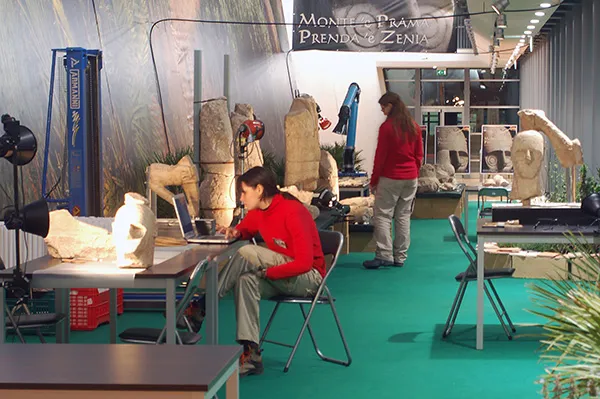
Archeological Conservation Center
From 2007 to 2011 conservators at Rome’s Archeological Conservation Center in Rome worked to prepare for the display of a mountain of carved stone fragments found at Mont’e Prama. The project, “Mont’e Prama–Prenda Zenia,” encompassed 5,178 fragments; 1,202 of them were reassembled into five statues of archers, four warriors, sixteen boxers, and thirteen models of nuraghe (the ancient conical towers of Sardinia). The conservators’ watchword was absolute respect for the original material, and they were committed to doing only fully reversible work—that is, treatments that could later be undone without damage to the object.
The project was a multidisciplinary effort uniting conservation, museology, public engagement, community involvement, and communication—on a regional, national, and international level. It has rewritten what we know about western Mediterranean culture and art, and has —after thirty centuries of oblivion—restored a major component of Sardinia’s history to the people of the island, bringing a new awareness of, and pride in, this fascinating cultural phenomenon.
Restoration experts used a light touch as they assessed and cataloged the fragments from Mont’e Prama.
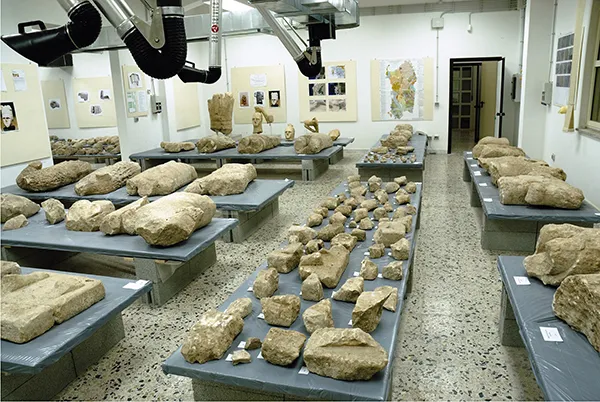
Tables of fragments
Tables full of fragments awaiting the planning and execution of the restoration are found in the many rooms of the restoration building in the city of Sassari, the Li Punti Center.
Nearly thirty centuries after the statues were made, in 1974 a farmer named Sisinnio Podda accidentally unearthed some pieces in Cabras (in western Sardinia), and he reported this find to local authorities, sparking the archaeological excavation of 1975–1979.
Dr. Antonietta Boninu, the archaeologist of the Soprintendenza per i Beni Archaeologici (Superintendency for Archaeological Heritage) in the city of Sassari, led the massive feat of restoration and preservation. She set up the Li Punti Center for restoration and preservation in Sassari, along with Gonaria Demontis and Alba Canu of the Superintendency.

Tables full of fragments awaiting the planning and execution of the restoration are found in the many rooms of the restoration building in the city of Sassari, the Li Punti Center.
Documentation of the restoration
The team at the Li Punti Center ran a series of crucial preliminary operations before they could start processing the fragments: the pieces were photographed, studied, assigned an inventory number, documented, registered, and entered in a database. The most vulnerable fragments were then identified and treated with appropriate techniques based on an analysis of their degradation.
The team did chemical, physical, and petrographic investigation of the original material, checking surface deposits—both natural and artificial—and the forms of deterioration.
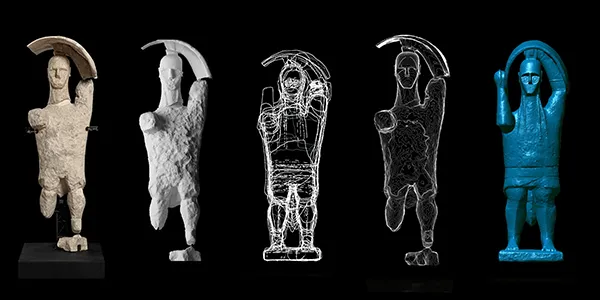
From the start, so much data was being gathered and recorded and the number of fragments was so huge that it was essential to create a digital archive to allow for the easy handling of all the information collected.
The documentation process includes photographic reliefs, three-dimensional scans, and digital reconstruction of the original shapes.
What damaged the stone surfaces? After the condition of the stone was assessed and documented, and after the degradation process was understood, the team proceeded with the treatment of the stone. They used a “soft” approach: the bare minimum of interventions, each one performed with deep respect for the material, the original finishes, the patina of time, and the marks of history so that the Mont’e Prama sculptures now on display could be a myriad of stone fragments restored—without transformation—to their original arrangement. The cleaning was done in phases, starting with the most delicate and mild techniques and moving on to increasingly strong procedures to address more tenacious surface deposits.
Conservators engaged in the restoration work for more than 5,000 working days.
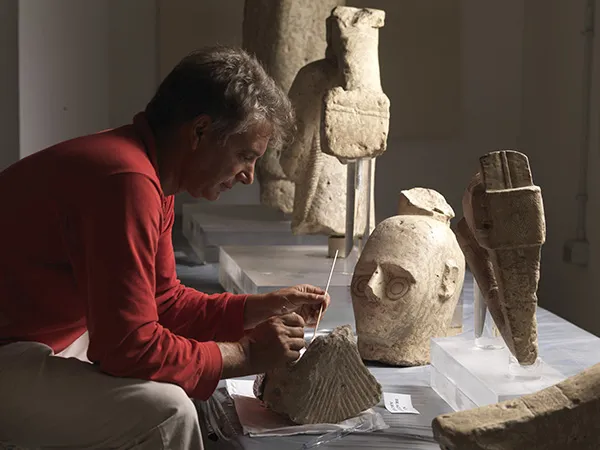
Once the cleaning was complete, the team moved on to consolidation—gluing together contiguous fragments. All the cracks and contact lines in the fragments were grouted with a lime-based mortar that was compatible with the original material in terms of color and chemical structure. In the case of fragments that were not contiguous, the team chose not to glue parts together.
No pins were permitted, and no holes were made while reassembling the fragments: this was an imperative for the whole project, which was guided by the principle of maximum respect for the original material.
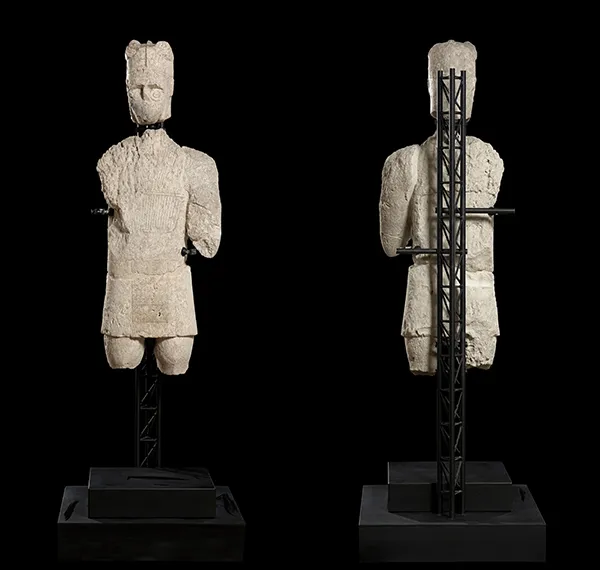
Whether the sculptures were human statues or models of nuraghe models, they each needed to be mounted on a vertical support. These supports had to fade into near invisibility but also ensure absolute stability for the sculpture while being easy to handle inside the museum spaces (they are heavy and bulky, but they need to be lifted with simple tools, such as a pallet jack). So the team chose materials with high resistance, low technology, and compact dimensions. And they designed a framework consisting of a central column behind the statue’s back with horizontal arms that support the protruding parts of the statue.
The sculptures stand up against metal supports created through collaboration among archaeologists, conservators, engineers, and ironworkers.